Polygon Casino Games
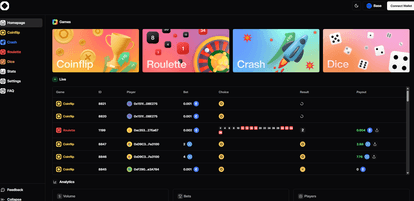
Polygon casino games suite - coinflip, dice, roulette, and crash - with Chainlink VRF for verifiable random outcomes. On-chain bet settlement, price oracles for non-native token profit conversion, and provably fair casino game logic players can audit independently.
Project Overview
Polygon casino games suite - coinflip, dice, roulette, and crash - with Chainlink VRF for verifiable random outcomes. On-chain bet settlement, price oracles for non-native token profit conversion, and provably fair casino game logic players can audit independently.
A multi-game on-chain casino on Polygon covering Coinflip, Dice, Roulette and Crash. All random outcomes use Chainlink VRF for provably fair generation, so the operator cannot bias games.
I wrote the base game contracts in Solidity with ethers.js + React on the frontend. Non-native token profits are converted via price oracles into native token shares for the reward pool, making reward accounting consistent regardless of the token players bet with.
Technical Implementation
Architecture
A modular architecture cleanly separating on-chain programs, low-latency data ingestion, and the user-facing app. On-chain code is written in Rust or Solidity with strict test coverage; off-chain services run on Node.js / Rust backends with Redis and PostgreSQL for hot and durable state respectively, containerized for reproducible deploys.
Smart Contracts
Programs are implemented in Rust with the Anchor framework on Solana, or in Solidity on EVM chains, with strict access control, exhaustive error handling, and gas / compute-unit optimization. Every state transition is covered by unit and integration tests before mainnet deployment.
Performance & Reliability
Where the project is performance-sensitive, the hot path is optimized end-to-end: zero-copy parsing, connection pooling, Redis-backed caches, Jito / Nozomi inclusion for Solana, and careful batching for EVM. Monitoring and alerts cover latency, inclusion rate, and PnL so regressions surface immediately.